Mountain Climb: Stunt Car Game
- 4.4
- Rating
- 100.00M
- Installs
- Free
- Price
 Analysis by App-foxy
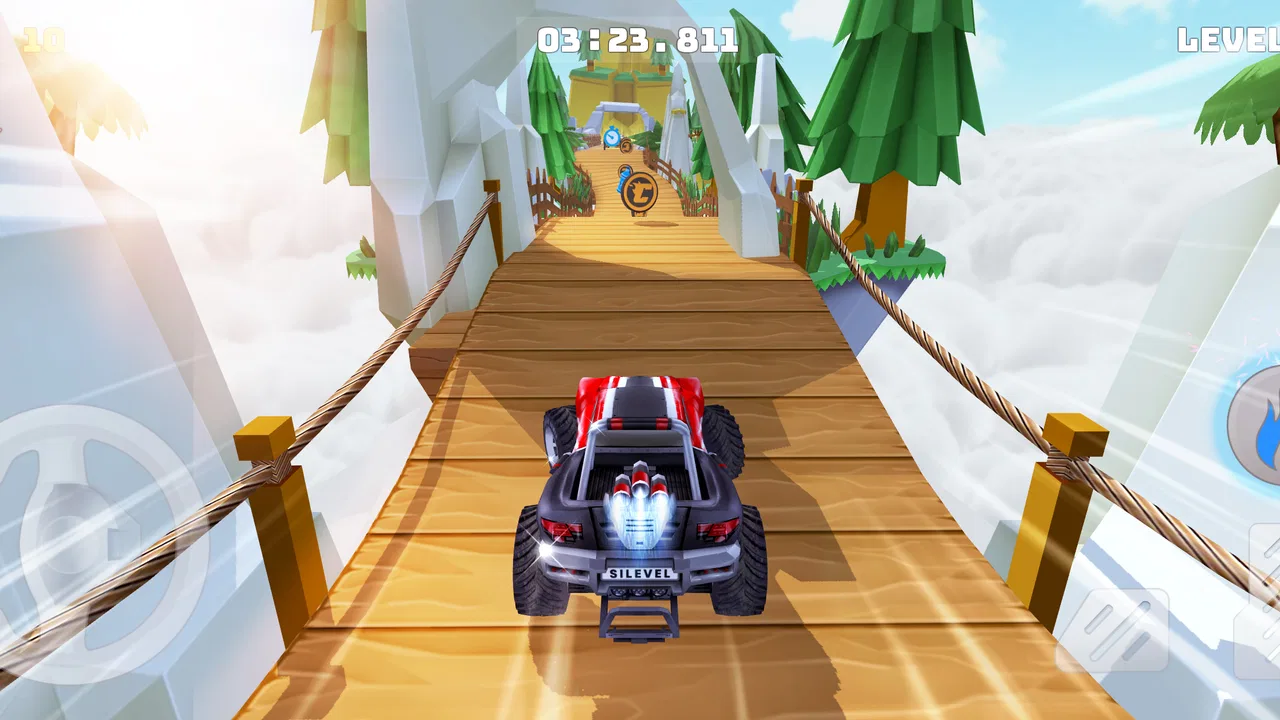
I first approached Mountain Climb: Stunt Car Game as a quick racing game for short breaks, but it works best when treated as a compact stunt-driving challenge rather than a conventional race. The appeal is the physical feel of climbing, balancing, and recovering a car on uneven mountain routes. You are not simply trying to follow a smooth circuit; you are constantly judging speed, landing angle, and how much control to keep when the track becomes awkward.
That distinction matters in a household where the same phone or tablet is used by several people. One person may enjoy the driving challenge, another may only want a few minutes of silly stunt action, and a younger player may be attracted by the cars without understanding why careful throttle control matters. In my experience, the game is easy to hand over, but it is not automatically easy to master. The controls are approachable, while the terrain creates the real learning curve.
How the mountain-driving format works in everyday use
The game belongs to the racing category, although its strongest identity comes from climbing and stunt driving. Its store summary presents it as a realistic racing and driving experience, and I found that the useful part of that promise is the need to manage the vehicle over changing surfaces. The fun comes from making a clean ascent, surviving a rough landing, or correcting a mistake before the car loses its rhythm.
You May Also Like

 Blood Strike: 2.5 Anniversary
Blood Strike’s Loadouts Turn Every Drop Into a Tactical Gamble
A close look at Blood Strike’s custom loadouts: how fast access to signature weapons reshapes its battle royale rhythm, rewards preparation, and narrows the gap between fights.

 Pandora - Music & Podcasts
Pandora’s Music Is Easy to Start, but Harder to Recover
Pandora’s strength is its low-effort path from a seed to a station. Its weak spot is how much confidence it asks you to place in connection, setup, and quiet recovery.

 8 Ball Pool
 Is Built on Rivalries, Rematches, and Routine
A close look at the rivalries, rematches, shared routines, and unanswered safety questions that turn a quick pool match into a persistent mobile community.

 Samsung Music
’s Quiet Strength Is Playing What You Already Own
Its reach comes less from spectacle than from dependable access to a personal library. That simplicity is both the app’s strongest retention engine and its ceiling.

 AccuWeather: Weather Radar
AccuWeather Review: A Quick, Clear Forecast for Everyday Decisions
For everyday plans, the best forecast is the one you can understand quickly. AccuWeather makes rain timing, radar, and local conditions easy to act on, with a few trade-offs.

 Hill Climb Racing
Why Hill Climb Racing Still Turns Crashes Into One More Run
A tiny car, a bumpy hill and one more upgrade: Hill Climb Racing keeps resurfacing because its simple chaos makes every near-miss feel personal.
More From Our News Desk
View All News


This makes it a good fit for short sessions. If I have only a few minutes, I can start a run without needing to remember a complicated story or a large set of objectives. It also suits shared play in a loose, turn-taking way: one person drives, the next person tries to improve the result, and everyone can immediately see whether a different approach works better. It is less suitable for a group expecting a formal multiplayer race, because the experience is centered on individual driving rather than direct competition between several players.
A realistic household scenario would be a child using a family tablet after school while an older sibling watches and offers advice. The sibling might suggest slowing down before a steep rise instead of holding the accelerator, then take a turn to demonstrate. That kind of cooperation is where the game has more value than its simple premise suggests. It creates a natural conversation about timing and control without requiring the device to become a dedicated gaming console.
Why the driving feels different from ordinary racing
In a typical arcade racer, speed is usually the main reward and contact with the track is something to take for granted. Here, the track itself is the problem to solve. A fast approach can help clear an obstacle, but too much speed can make the landing unstable. A cautious approach preserves control, yet may leave the car without enough momentum to climb. I found that the enjoyable decisions happen in this narrow space between confidence and overcorrection.
The stunt aspect also changes how I judge a successful run. Finishing a section cleanly can be more satisfying than simply moving quickly. When the car begins to tilt, the instinct is often to react immediately, but a small, measured correction can be better than a dramatic one. This is one of the game’s less obvious lessons: the most impressive-looking attempt is not always the most effective one.
Setting up a shared device without making assumptions
The game is free to download, which makes it easy to try on a household device before deciding whether it deserves regular space. It supports Android devices running version 7.0 or later, so compatibility should be checked against the particular tablet or phone being used. The current version is 8.7, and the game has been available since April 9, 2018, giving it a longer presence than many short-lived mobile racing releases.
For shared use, I would establish a simple boundary before handing over the device: decide who is playing, how long the session lasts, and whether purchases are allowed. The game includes in-app purchases ranging from $0.99 to $9.99 per item. That does not make the game unsuitable for a family, but it does mean the device owner should handle purchase decisions rather than leaving them to chance during an enthusiastic session.
I would also keep the game in the same place on a shared home screen and agree that the player should stop before switching to another app. That sounds mundane, but it prevents the common household problem where one person picks up the device expecting a quick turn and discovers that another user has left the game open. The game is most convenient when everyone treats it as a turn-based activity, even if the app itself is not built around formal family accounts.
One practical tip is to use a short demonstration turn before allowing a younger player to continue alone. Show how gentle adjustments can be more useful than constant full-speed driving. This reduces frustration and helps the player understand that failing on a climb is part of learning the route, not proof that the controls are broken.
Coordinating turns and keeping the experience fair
Mountain driving naturally creates a useful handoff point: one person attempts a section, then another tries the same kind of challenge. To keep that fair, I would agree on a simple rule such as one attempt each or a fixed time per turn. Without a boundary, the strongest player can keep restarting until the result looks perfect, while everyone else becomes an audience instead of a participant.
The game works particularly well when the household treats advice as optional rather than as constant correction. A viewer can point out that the car is approaching a rise too quickly, but the driver still needs room to learn the timing personally. I noticed that back-seat coaching becomes less helpful when several people give instructions at once. One clear suggestion is enough; the game already demands attention from the person holding the device.
For siblings or friends, a useful challenge is to compare driving styles rather than only final results. One player may prefer steady progress, while another may take risks for more dramatic stunts. This keeps the activity interesting even when the players have different skill levels. It also avoids turning every session into a contest that only the most experienced driver can enjoy.
Another non-obvious strength is that the game can support quiet cooperation. A child can drive while an adult helps identify when patience is needed, or an experienced player can explain why a failed landing happened. That makes it a better shared-device choice than a game that depends entirely on rapid reflexes and leaves spectators with nothing to do.
Age context, trust, and the limits of supervision
The content rating is Everyone, so the game is positioned for a broad audience. In practical terms, the main age issue is not frightening content; it is whether the player can handle repeated attempts without becoming upset. The driving can look simple at first, but uneven terrain rewards practice. A younger player may enjoy the movement and stunts immediately, while needing an older person to explain why holding the controls constantly is not always the best strategy.
I would not treat an Everyone rating as a replacement for household judgment. Children differ in patience, impulse control, and understanding of purchases. Since the game is free but offers paid items, the responsible adult should make the device’s purchase rules clear. If the phone or tablet belongs to several people, it is also sensible to agree that no one changes settings or spends money without asking the owner.
The game is better for families who are comfortable with informal supervision than for anyone looking for a tightly managed child profile. It can be part of a trusted routine, but the routine has to come from the household. I would explain that a free download does not necessarily mean every optional item is free, then let the player focus on driving.
There is also a social trust question. If several people use the same device, progress or preferences may be associated with whoever is playing, depending on how the app handles its session. I would avoid promising a separate experience for every family member and instead use clear turn-taking. The safest expectation is that shared play works through communication and device rules, not through assumed account separation.
Where it stands beside other mobile racing choices
Compared with a polished circuit racer, this game is less about overtaking opponents through a full race and more about controlling a vehicle across difficult terrain. Someone who wants licensed cars, organized championships, or head-to-head competition may prefer a traditional racing title. Those games usually offer a stronger sense of progression for players who want long-term competition and detailed customization.
Compared with an endless runner, Mountain Climb offers a more deliberate form of challenge. You are not merely reacting to an uninterrupted stream of obstacles; you are trying to understand how momentum and balance work on the route in front of you. That makes it a better choice for players who enjoy repeating a section to improve technique, but a weaker choice for anyone who wants instant, effortless action.
It also differs from a pure stunt sandbox. The mountain setting gives the driving a practical goal: get through the terrain rather than simply perform the most spectacular flip. I like that compromise because it gives stunts a purpose, although players seeking a large open world may find the format more focused than they want.
The strongest comparison is therefore not about graphics or the number of cars. It is about the type of attention the game asks for. Choose it when you enjoy small driving problems, repeated attempts, and the satisfaction of a clean climb. Choose another racing game when your priority is competition, realism across a complete motorsport structure, or a deep social mode.
Small techniques that make repeated attempts more rewarding
My first useful adjustment was to stop treating every slope as a request for maximum speed. Momentum matters, but a car that reaches a rise too aggressively can become difficult to settle afterward. I had better results when I approached uncertain sections with enough power to keep moving while leaving room to correct the vehicle.
A second tip is to watch the car’s attitude rather than focusing only on where the front wheels are going. A landing can look successful for a moment while the body is already angled toward trouble. If I pay attention to the whole vehicle, I can make smaller corrections and avoid turning a recoverable wobble into a full mistake.
Third, I would use a shared session to test one change at a time. If one player changes speed, timing, and control direction all at once, it becomes impossible to know what helped. Try a slower approach on one attempt, then a more committed approach on the next. This turns casual play into a simple experiment and gives younger players a clear way to improve without making the game feel like homework.
These techniques are especially helpful on a touchscreen, where a player may assume that more input always produces more control. In this game, restraint can be a form of control. That is the kind of detail a short store description cannot communicate, and it is why I found the driving more interesting after the initial novelty of the stunts faded.
Performance expectations and everyday friction
The game has reached over 100 million installs and holds an average rating of 4.6 from around 131 thousand ratings, which suggests that its straightforward driving idea has connected with a large audience. Those figures do not guarantee that every device or player will have the same experience, but they do place the game firmly among familiar mobile racing choices rather than obscure experiments.
Its free entry point is convenient, especially for a shared tablet where several people may want to try it before committing to a particular game. The trade-off is that optional purchases require attention. I would not let a child explore purchase screens alone, and I would avoid presenting the game as completely cost-free simply because installation does not require payment.
The main friction is repetition. Players who enjoy mastering a route can find repeated attempts satisfying, but anyone who needs constant new events may lose interest. The game’s focused climbing format is its identity, and that same focus limits its variety compared with broader racing packages. I also would not choose it as the only game on a household device if different users expect very different genres.
Another limitation is that the game’s appeal depends heavily on personal tolerance for imperfect runs. A player who enjoys recovering from a bad landing will keep experimenting. A player who becomes annoyed whenever a climb fails may see the same design as unfair, even when the failure comes from approaching too quickly. A short supervised trial is the best way to find out which reaction applies.
Who should install it, and who should pass
I recommend it to casual racing fans who like stunt driving but do not need a formal tournament structure. It is also a good candidate for a shared household device when players are willing to take turns, discuss strategies, and accept that improvement comes from repetition. The Everyone rating and free installation make the first trial uncomplicated, while the simple premise means a new player can understand the goal quickly.
I would be more cautious for someone looking for a deep competitive community, a story-driven campaign, or a highly organized collection of motorsport events. This is not the game I would choose for a serious racing simulation fan who wants detailed race weekends and precise vehicle tuning. Nor is it ideal for a family that wants automatic separation between every user’s progress and spending decisions.
For a child, I would pair it with a clear rule about turns and purchases. For an adult, I would frame it as a short skill game rather than an endless source of new content. For a mixed-age group, I would encourage cooperation: let the less experienced player drive while the more experienced person offers one suggestion at a time.
My household verdict
After spending time with it, I see Mountain Climb as a friendly, focused racing game whose best quality is the way it turns ordinary driving into a sequence of small judgment calls. It is easy to share, quick to understand, and entertaining when several people compare approaches. The mountain setting gives the stunts a clear purpose, while the need to manage momentum prevents the experience from becoming completely mindless.
My recommendation comes with two boundaries. First, treat the free download and the optional purchases as separate things. Second, treat shared play as a household agreement rather than assuming that the app will solve account separation or turn management for you. With those expectations in place, it can work well on a family phone or tablet.
The best reason to try it is not the promise of speed; it is the satisfaction of learning how little control is sometimes enough. If that sounds enjoyable, this game is worth a place in a casual racing rotation. If you want direct multiplayer competition, a long campaign, or detailed simulation systems, another racing title will serve you better. For short turns, friendly coaching, and repeatable mountain-driving challenges, I would gladly recommend it to a friend.
It is developed by Silevel Games Ltd, is free to play, and is suitable for Everyone. With its broad device compatibility from Android 7.0 onward and a current version of 8.7, it remains an accessible option for households using older as well as newer Android hardware.
FAQs for Mountain Climb: Stunt Car Game
01What is the main objective of Mountain Climb: Stunt Car Game?
Mountain Climb: Stunt Car Game challenges players to navigate through treacherous mountain terrains using a variety of stunt cars. The main objective is to complete each level by reaching the endpoint, while performing stunts and overcoming obstacles. Players must master their driving skills to avoid falling off cliffs or crashing.
02Is Mountain Climb: Stunt Car Game suitable for all age groups?
Mountain Climb: Stunt Car Game is designed for players of all ages who enjoy driving games with a focus on stunts and challenges. However, younger players might find the controls and some levels challenging. Parental guidance is advised to ensure the game is suitable for younger children based on their skill level.
03Does Mountain Climb: Stunt Car Game require an internet connection to play?
No, Mountain Climb: Stunt Car Game can be played offline, making it a great option for users who want to enjoy gaming on the go without relying on an internet connection. However, an internet connection may be needed for downloading updates or additional content.
04What kind of vehicles are available in Mountain Climb: Stunt Car Game?
The game offers a variety of stunt cars, each with unique attributes such as speed, handling, and durability. Players can unlock and upgrade vehicles as they progress through the game, allowing them to customize their driving experience and tackle more challenging levels effectively.
05Are there in-app purchases in Mountain Climb: Stunt Car Game?
Yes, Mountain Climb: Stunt Car Game includes in-app purchases that allow players to buy upgrades, new cars, or other enhancements to improve their gameplay experience. While the game can be enjoyed without spending money, these purchases may help players progress faster or customize their experience.
Pros
- Stunning graphics enhance immersion.
- Wide variety of challenging levels.
- Realistic physics for engaging gameplay.
- Intuitive controls make it accessible.
- Regular updates with new content.
Cons
- In-app purchases can be pricey.
- Ads may interrupt gameplay.
- Requires a stable internet connection.
- Limited vehicle customization options.
- Can be resource-intensive on older devices.

Mountain Climb: Stunt Car Game
Gallery